Time then to take a look at the Denver Broncos offense and in particular the option read/zone read (depending on your preferred terminology) that has propelled Tim Tebow to even higher levels of stardom, predominantly because it's seen as a contrary offense and because the option isn't supposed to work in the NFL... despite the fact that it's been working nicely all season for a number of teams.
This is probably the main reason that we need to look at this, because despite the immense success that Denver has been having people still seem to believe that such an offense can't work in the NFL. This, even in the face of week after week of evidence that should have dispelled that myth, a bit like the Lions being rated as a play off team (sorry Lions fans).
There are several reasons why this play works so well, not least because the Broncos offensive line is pretty good at run blocking, even if their pass protection is... shall we say, underwhelming? Then there's the fact that Tim Tebow ran this play God knows how many times during his college career with Florida, so he has a very good feel for the play and knowing when to keep the ball and when to give it to the running back.
But fundamentally it's about numbers.
See the problem that every offense has is that on any given run play they are basically short handed by two men; the quarterback and the running back. The quarterback hands the ball off and is in no position to block anyone, even if he were inclined to do so. The running back is carrying the ball and thus is also exempted from blocking duties. That leaves only nine men left to block eleven, and to be honest at least two of those blockers are likely to be wide receivers so it's more like seven on eleven, minus any cornerbacks who take the Deion Sanders "business decision" approach to tackling. Option plays try to remedy that problem to a degree.
Now I can already hear all the coaches out there currently repeating the oft used mantra of "It's about Jimmy's and Joe's, not X's and O's!" which when translated from coach speak into normal person speak, roughly means; "Winning in Football is about teaching players the skills of the game, motivating them and using an offense they can understand, not drawing pretty diagrams," or words to that effect.
And while broadly speaking I agree with that sentence, I also think pretty diagrams (or even ugly ones like mine) have an important role to play in helping offenses to mitigate some of their deficiencies, while maximising their potential. Option plays are a great example.
Basically the play involves the offense purposely leaving one player completely unblocked. Now that might sound like quite a stupid thing to do, but the offense has a plan. What they're going to do is to make that unblocked defender make a choice. They're going to give him two conflicting options and make him pick one. Let's throw up a quick diagram so we have a better idea of what I'm talking about;

As you can see in my superbly drawn diagram (stop laughing) I've circled the unblocked defensive player in red. The offense is going to make this player chose between chasing after the running back or staying "home" to defend against the quarterback. Due to the direction that the offensive players are running in (opposites), it's impossible for the defensive end to cover both men on the play. If he's to have any chance of making an impact then he has to make a decision and he has to make it early, committing himself to his decision.
This is where the "option" in option football comes in. The quarterback has the option of either giving the ball to the running back or keeping it himself, depending on the reaction of the unblocked defender; if he races hard down the line then the quaterback keeps the ball and runs around the exposed end himself. If the defender sits back cautiously and just watches the quarterback, or even comes hard up the field on a pass rush, then the QB hands it off to the back (imagine someone like Jared Allen trying to chase a running back down from behind when the back has a 4-5 yard head start).
To give himself a bit more time to make the read and to be sure of the defenders decision, the quarterback will often take two small sliding steps in the direction the running back is headed, all the while with his body turned towards the unblocked defender and the ball extended out into the path of the back (the "mesh" that you're always hearing about). He then either gives it to the back or pulls it out and takes it himself.
It's because this "give/take" decision has to be made in such a short time window - and because of the trickiness of the ball handling - that it really helps immensely to have an experienced quarterback (at least with regards to this play) like Tebow in there running it. This is not a play that you want to just run on a whim with any old quarterback, because the consequences of a bad read or a mishandled mesh can be serious, with your quarterback running right into the arms of a 270 pound defensive linemen or a fumble that is likely to bounce towards the waiting defense.
Now hopefully, after we've gone to all that trouble to fake out the end defender, our linemen should have made their blocks. Depending on the front used by the defense the offensive line will either have a numbers advantage, or at the very least have one on one blocks across the board ("a hat on a hat" as they say). Let's take a look at how this play can end up panning out;

As demonstrated once more by my elite drawing skills you can see at the top that when the end crashes down (or he could just be sitting in that hole) the quarterback will give the ball to the back. That leaves us with six linemen blocking six defenders and a running back looking for a hole. At the bottom you can see the unblocked defensive lineman is pressing hard down the line trying to get to the running back which - along with the blocks of the offensive line - leaves the backside of the play wide open for the quarterback to pull the ball and run through. In actuality the quarterback would take a slightly more horizontal first few steps just to make sure he got around that end ok, but I'm too lazy to go back and adjust the diagram now.
So we've seen how the option read/zone read works (the "zone" in "zone read" comes from the offensive linemen using zone blocking). The question now switches to the opposite side of the ball and the defense's perspective. Simply put; how do you stop this play?
The common approach touted by your TV talking head of choice is likely to go something along the lines of "you play sound, disciplined, assignment football". That is to say that each of the defensive players should stick to their normal run gap and fill it in exactly the same way that they would against any other running play.
Which is probably one of the worst things that you could do against this play.
See the problem you have by playing disciplined, assignment football is that your defensive end, the unblocked guy, is going to sit at "home" and play contain on the edge. He's going to attack downfield at the snap (he has to assume the offense might try and pass) but the second that he sees the quarterback making the read during the mesh with the running back, he's going to stop and start protecting the edge of the defense.
And the quarterbacks just going to hand the ball off every time to the running back.
With the end standing still he's effectively taken himself out of the play, which is precisely what the offense wants. In fact it's probably the best outcome for the offense, because it means you're giving the ball to your dedicated running back and not risking your quarterback taking a big hit. This is worth just settling on for a second because this is - at least in my opinion - going to be the primary limiting factor for this play in the NFL.
Not many coaches are going to be willing to risk their multi-million dollar quarterback taking too many lumps over the course of a full 16 game season every year. While it won't stop the zone read - any play that can surprise a defense and get yards will stay in the NFL for as long as it's effective - I do think that we'll see less and less of it as guys like Tebow and Cam Newton develop as passers. We'll still get the odd treat, just not as often.
Anyway, back to the defense. So if they can't play assignment football to beat the zone read, then what can they do? The simple answer is for the defense to pull a fast one and install a special defensive play just to counter the zone read. Now that might sound like a lot of effort for the defense just for the sake of one play, but it's really only a subtle variation on the way they would normally defend a play like this.
They key for the defense is understanding that the quarterbacks decision of whether to give or take is based on what the unblocked defensive man does. As we've seen, if the unblocked man drives hard down the line then the quarterback will pull the ball back and try to take it around the end himself.
With that in mind the defense can now take the initiative away from the offense and force the offenses hand. All you do is you tell that defensive end to crash down the line the second he sees the zone read play developing, safe in the knowledge that the quarterback will see it, take the ball, and run it himself around the edge. Now here's the clever bit.
Knowing that you've got the quarterback to react as planned (he sees the end crashing so he takes and runs) you now get your linebacker on that side to forget about chasing the running back and tell him that the second he recognises a zone read he should come charging down and fill the outside gap. The quarterback will come flying around the edge thinking he's in for a big gain when suddenly...
BOOM!!
He gets blown up by your linebacker scraping around the edge. Let's have a look at that in a diagram form. I know you can't wait to see more of my artistic talents on display;

As you can see from the large "BOOM!!" marker, the defense has tricked the quarterback into keeping the ball and trying to run around the edge, where he's met by the linebacker making a deliberate and immediate move towards the edge. In reality, obviously the quarterback often sees the linebacker coming and more often than not takes evasive action as only a quarterback can; by diving or sliding immediately into the dirt/plastic.
Which now puts the ball firmly back in the offenses court. If the defense is going to force the quarterback to carry it (he can try handing it off but if the running back so much as hesitates then he's dead meat) and the linebacker is just going to come down and fill that gap, what does the offense do now? Zone read stuffed?
Not quite yet.
If the defense is going to force the quarterback to keep it around the end and then bring a different player down to fill gap, then the logical reaction to this is to introduce another offensive player into the mix and simply read off the second defender; a triple option (quarterback, running back, wide receiver).
The best way to achieve this is to line up a receiver in the slot to the right (presuming the offense is set to the right as in the diagrams above) and then send that receiver in motion behind the quarterback (you can also line him up to the quarterbacks right side in a shotgun/split backs look). Just as he's approaching the rear of the quarterback you snap the ball and the quarterback makes the zone read as normal.
If he sees the unblocked defensive end chasing down the line then he keeps the ball and takes it around the end as he normally would on a zone read, except that now he's going to have a wide receiver running outside of him ready to receive a pitch. The quarterback is now looking out for that linebacker coming down to fill the gap. If he goes towards the quarterback then the quarterback pitches it to the receiver. If the linebacker tries to get wide and cover the receiver then the quarterback keeps it himself and runs right up through the ensuing hole.
Here's how it looks;
The wide receiver has to be careful to maintain the correct pitch relationship with the quarterback, making sure to stay slightly behind the quarterback so that any pitch doesn't go forward. If the quarterback crosses the line of scrimmage and then has to pitch the ball forward that's going to draw a flag.
Once again the offense has the defense in a bind. No matter what the linebacker does, he's going to be wrong. If he tries to take the quarterback then the ball is going to get pitched to the receiver. If the linebacker takes the receiver then he's going to let the quarterback run free inside of him.
All is not lost for the defense though. They will likely have a nickel back on the field covering the slot receiver, so when that receiver motions across the field the nickelback might get across in time to help out (or be as much help as a nickel back can be when it comes to tackling...)
Alternatively the defense can bring the free safety down and involve him in the option dilemma. In this case the defense can play a little game where they make the quarterback try and figure out whether the linebacker is covering him or whether the safety is. If the defense uses the linebacker to cover the wide receiver and brings the safety down to take the quarterback, then the quarterback can end up keeping the ball, running inside and running straight into the safety.
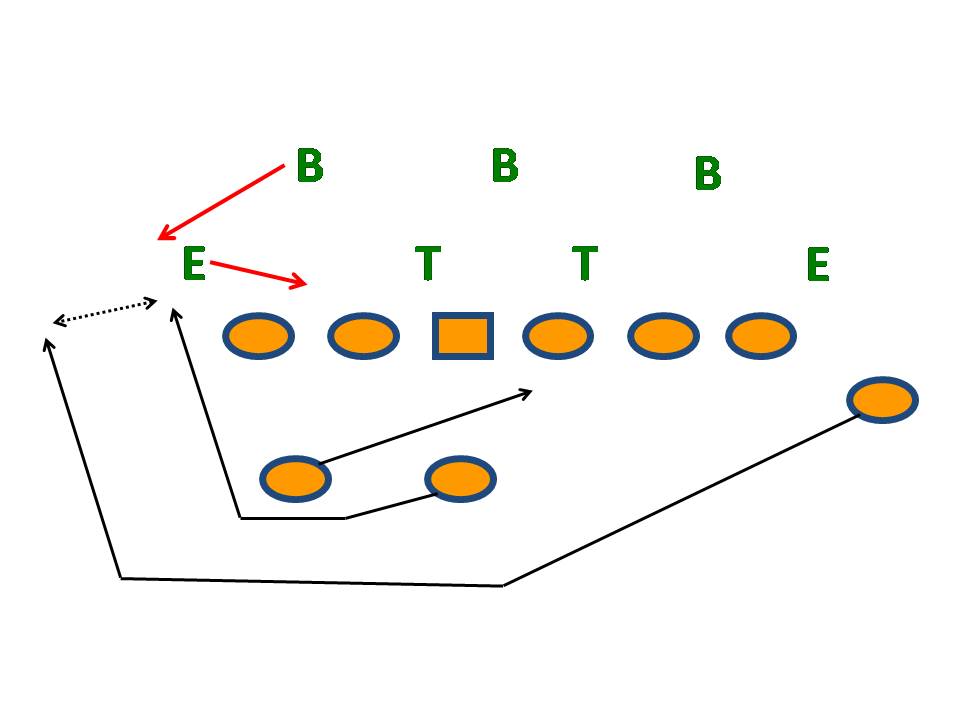
From there the offense can play its own games, by sending the slot receiver in motion, faking the initial step of the triple option play... but then having the fullback cut back to the outside and dive at the legs of the defensive end. Meanwhile the wide receiver stops and comes rushing back towards the quarterback to receiver a hand off going to the right, as the offense now plays a classic outside zone run;

And then of course there is play-action to be had off of that....
I think we'll leave it there for now. Suffice to say that the back and forth that started with a simple zone read can go on for hours as defenses figure out new ways of adjusting to and manipulating the offensive reads, while offense's finds new ways to make it harder for the defense to know who's being read, and hampering their efforts to cheat into position to take away certain plays, applying the constraint theory of offense.
That's one of the things that's so enjoyable about football; the back and forth that goes on between the coaches. And proof I feel that sometimes the X's and O's of football can be just as important as the Jimmy's and Joe's.
And even the Tim Tebow's.
Tomorrow I'll do my picks for this weekend and have a quick word about an interview that Cam Newton gave to ESPN, which I don't have time to write about now. See you then.
P.S. Thanks to Teoita for the inspiration for this article! If you have something you think I should write about or a subject you'd like to know more about, you can e-mail me at; keepingthechainsmoving@live.co.uk


